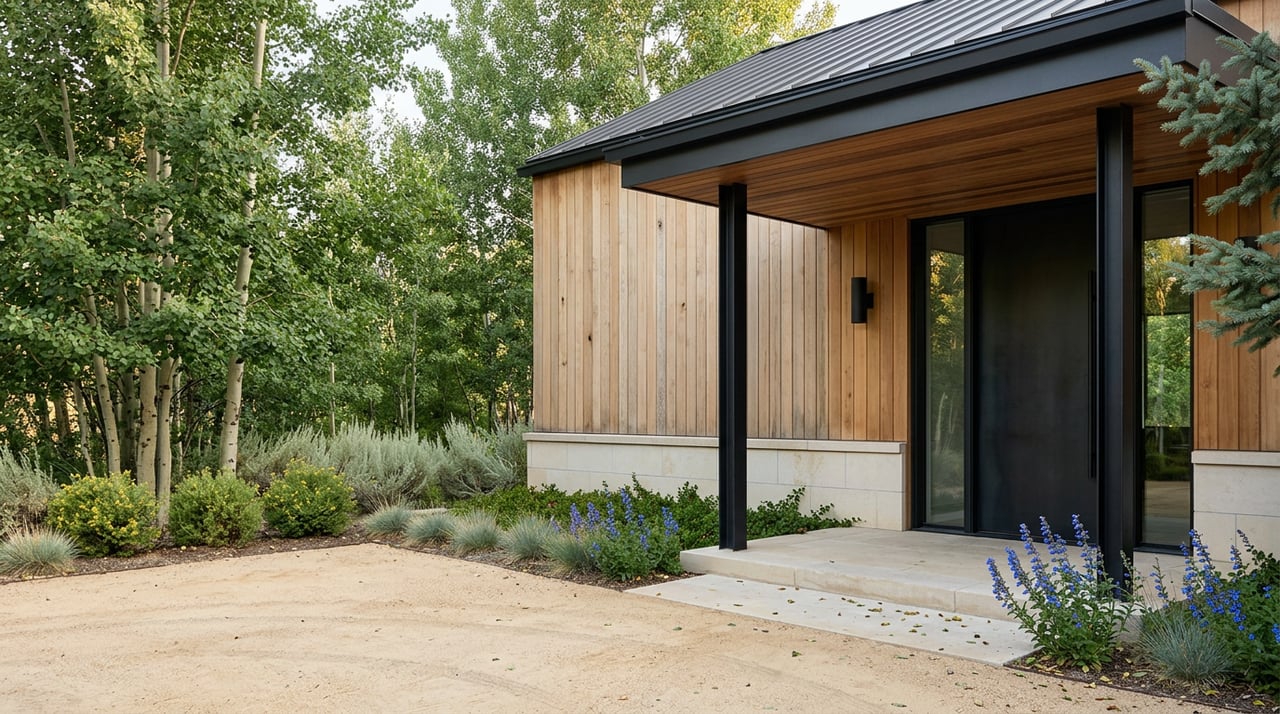
Mountain Star vs. Beaver Creek: What A $7 Million Budget Actually Buys In Avon
July 9, 2026
July 9, 2026
Most buyers arrive at Mountain Star through a portal that quotes the community somewhere between $1.5M and $6M. That range is wrong. Every home currently listed inside the gate sits above $6.6M, and the top of the active market is $11.75M. The gap between the published range and the real floor is not a rounding error. It is the entire story of how this enclave prices itself.
That gap exists because Mountain Star trades too thinly to show up in the aggregators the way Beaver Creek Village or Bachelor Gulch do. With only 90 homesites spread across roughly 1,300 to 1,500 acres, a normal year sees a handful of closings. Casual shoppers scanning median lines never see the actual water level.
The reframe: a Mountain Star budget is not buying a discount on Beaver Creek. It is buying a different asset entirely. Ski-in/ski-out access is traded for acreage, sun, and a private mountain that no one else on the valley floor can see.
Look at what is actively on the market inside the gate right now. 1268 Paintbrush is listed at $11.75M and 1006 Chiming Bells at $9M, both represented by LIV Sotheby's. 46 Jasmine sits at $8.625M, 84 Wild Rose at $8.5M, 1724 Paintbrush at $7.675M, 47 Woodviolet at $7.495M, 84 Shooting Star at $7.375M, 2005 Wildwood at $7.35M, and 1761 Paintbrush at $6.649M. Nine active listings, none below $6.6M, most clustered in the $7M to $9M band.
Against the wider Vail market in February 2026, which showed a median sale price of $1.323M, a median price per square foot of $796.50, and 5.1 months of supply on a seller-leaning tilt, Mountain Star is running roughly six times the valley median. That is not a "premium Avon" story. That is a discrete micro-market with its own supply curve, and one that a $2M "aspirational" search will never surface.
The interesting question is not whether Mountain Star costs more. It is what a buyer receives at that price that they cannot get in a comparable-dollar Bachelor Gulch or Beaver Creek Village property. Three things stand out.
| Attribute | Mountain Star | Village-Core Alternatives |
|---|---|---|
| Ski access | Short drive to Beaver Creek base | Ski-in/ski-out from door |
| Typical lot | 2 to 8 acres, some larger | Fractional to under an acre |
| Elevation | 8,200 to 9,200 ft | 7,400 to 8,100 ft |
| Aspect | North side, "sunny side" of valley | Mixed, often south-facing across valley |
| Density | 90 homesites total, >50% open space | Dense village or cluster |
| Community amenity | Ranch Central caretaker | HOA, resort services |
The tradeoff resolves cleanly. A buyer who will ski 40 days a year and cares about lift access from the mudroom is not a Mountain Star buyer. A buyer who wants a private mountain, morning sun on the great-room glazing through winter, and the ability to see a neighbor only if they choose to is paying for exactly the right asset.
The community sits on the north side of the valley, which locals call the sunny side because it faces south across the valley floor and holds daylight later into winter afternoons. Elevation ranges from roughly 8,200 to 9,200 feet, which puts most homes above the inversion layer that settles into Avon on cold mornings. Design guidelines push owners toward natural, indigenous materials so the built stock recedes into aspen groves and open meadow rather than announcing itself.
The community borders the White River National Forest. That matters in two ways for value. First, it caps the developable land on one side of the boundary permanently, which supports long-run scarcity. Second, it means trail access from home is not a marketing line, it is the ground condition. A buyer at $7M inside a village pays for walkability to restaurants. A buyer at $7M in Mountain Star pays for the forest.
Here is the mechanism that catches sophisticated buyers off guard. With 90 homes total and typical annual turnover in the low single digits, comps in Mountain Star are stale by definition. A public dataset averaging Avon-wide sales pulls in Wildridge duplexes, riverfront condos at Frontgate, and townhomes along the core. The average drags well below what any single Mountain Star home would actually clear.
The consequence: a seller who anchors to portal comps under-lists and leaves capital on the table. A buyer who anchors to portal comps writes an offer that never gets a return call. Both sides need actual closed-sale data from inside the gate, and much of it moves through relationships rather than search results. Roughly a third of the currently visible active listings are represented by LIV Sotheby's, which is not accidental. In a market this thin, the brokerages that hold the closed comps set the pricing conversation.
Days on market at the valley level ran 92 in February 2026. Inside Mountain Star, a well-priced home in the right price band can move faster than that, and a mispriced one can sit for a year. Time on market inside the gate is not a signal of demand. It is a signal of pricing discipline.
The friction is not in the closing. It is in the diligence a serious buyer needs to complete before writing an offer.
The clean profile is a family that already knows the valley, has skied Beaver Creek enough to know a five-minute drive to First Bank Express is not a lifestyle problem, and wants an asset that reads as a mountain estate rather than a resort residence. It is the buyer whose second home in the valley is a full second home, not a booked-out short-term rental. Dining density in Avon supports that lifestyle without a drive to Vail Village: Mirabelle in the historic farmhouse, Northside Kitchen for a fast breakfast before the hill, Vin48 for a wine-forward evening, Ticino when someone wants pasta.
How many homes actually sell in Mountain Star in a typical year? Thin. With 90 total homesites and long ownership tenures, closed transactions inside the gate are typically a handful per year. That is why public comp averages under-represent the price floor.
Is Mountain Star ski-in/ski-out? No. Beaver Creek is a short drive from the gate. Buyers who require lift access from the door should look at Bachelor Gulch or Beaver Creek Village instead.
Why do the aggregator price ranges look so low? Because they pool Mountain Star into broader Avon data, and because the enclave's actual sale prices move through relationship channels more often than portal search. The published low end reflects data gaps, not opportunity.
What is the elevation trade-off? Homes sit between roughly 8,200 and 9,200 feet. Buyers gain sun, views, and privacy above the valley inversion. They accept a longer drive to the base area and stricter insurance underwriting in return.
Mountain Star rewards buyers who understand what they are paying for and price the trade accordingly. If a confidential valuation of a Mountain Star home, or a discreet look at inventory that never touches the public search, would help clarify the decision, Tom Dunn and the LIV Sotheby's team can arrange it. Request a confidential valuation to start the conversation.
.
EXPLORE SIMILAR BLOG
October 22, 2026
October 15, 2026
October 8, 2026
October 1, 2026
September 24, 2026
September 17, 2026
September 10, 2026
September 10, 2026
September 3, 2026
Setting the highest standard for client satisfaction, Tom and his team not only helps their buyers and sellers achieve their real estate goals but provide them with a rewarding and enjoyable experience that turns many first-time connections into lifelong relationships.